
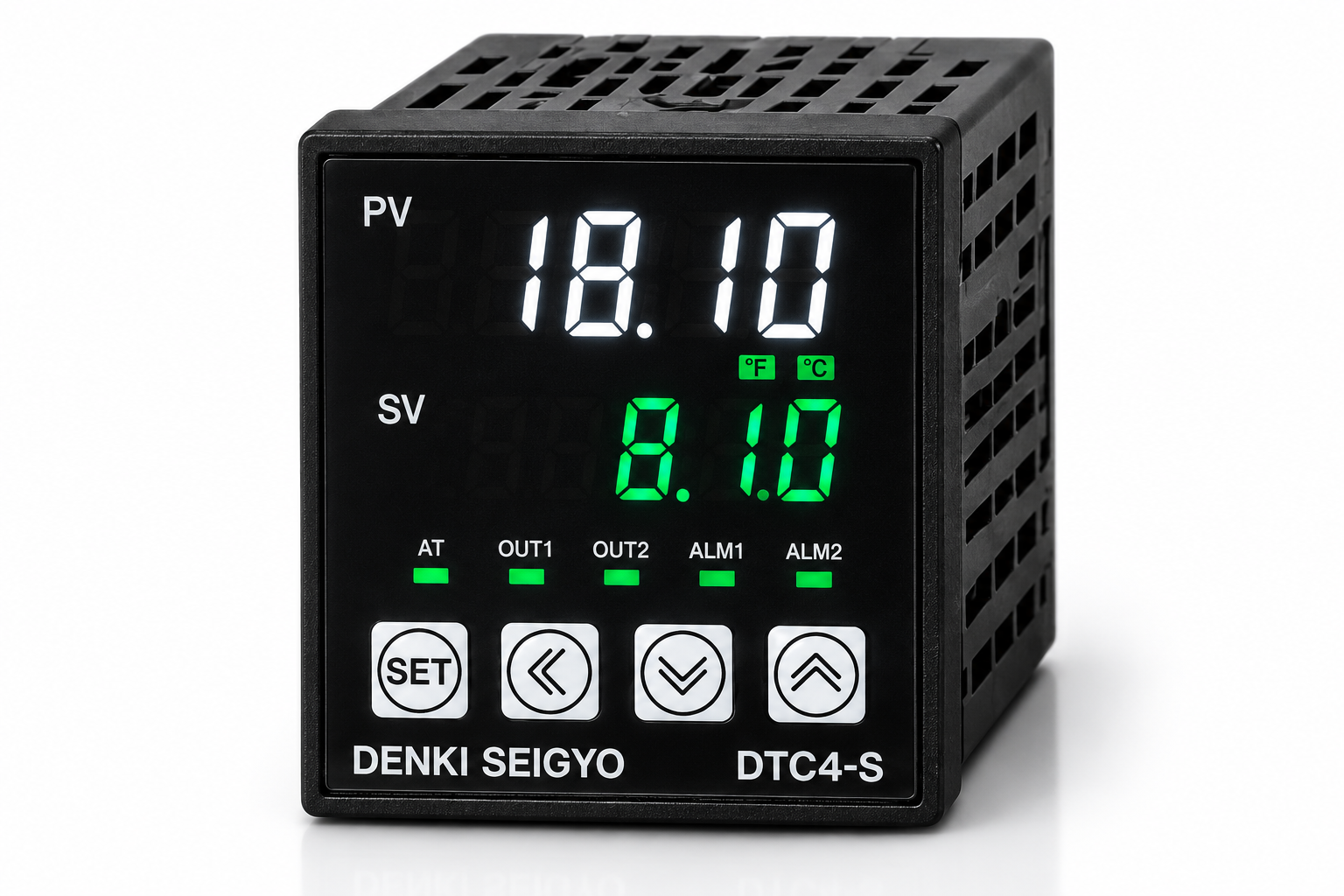
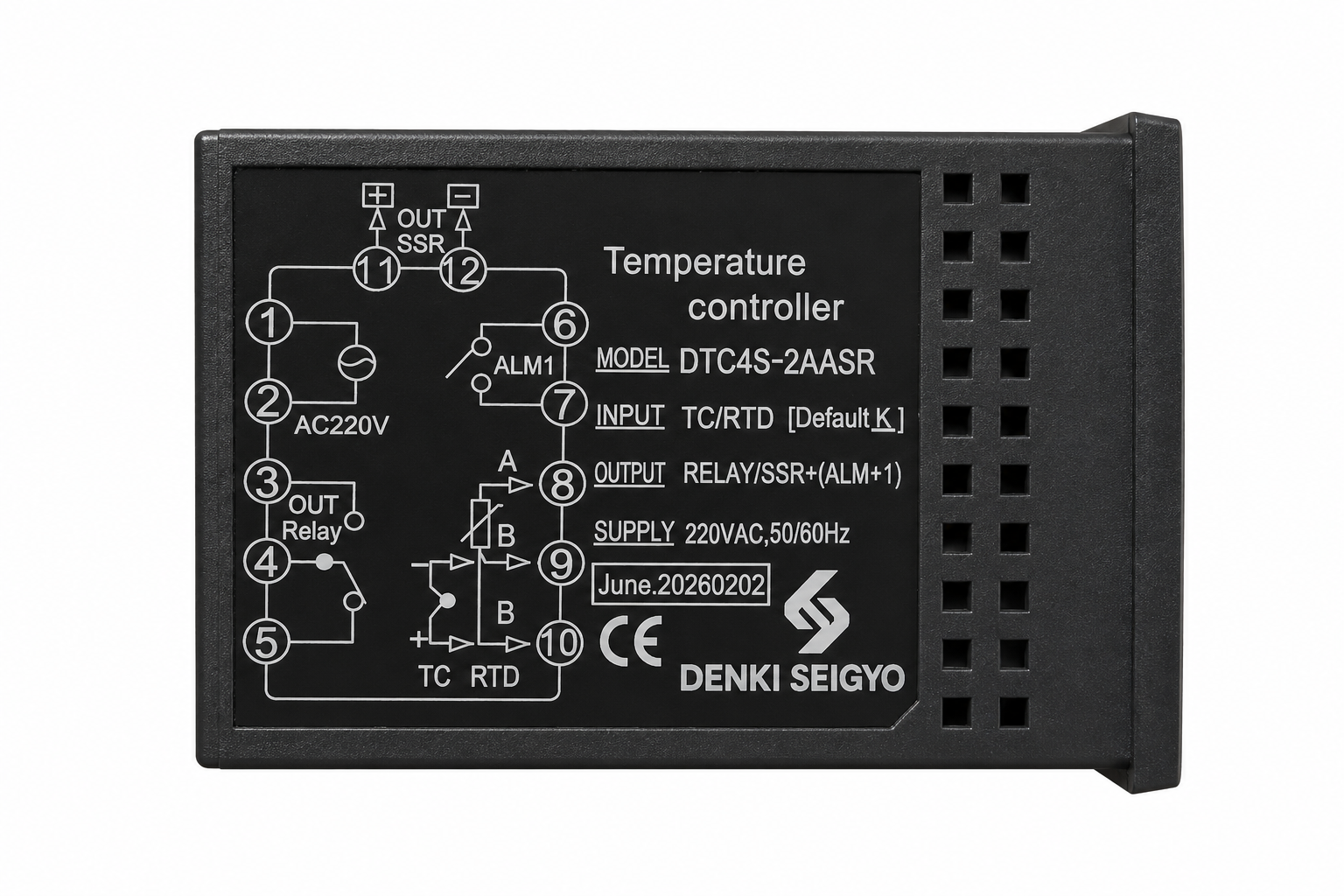
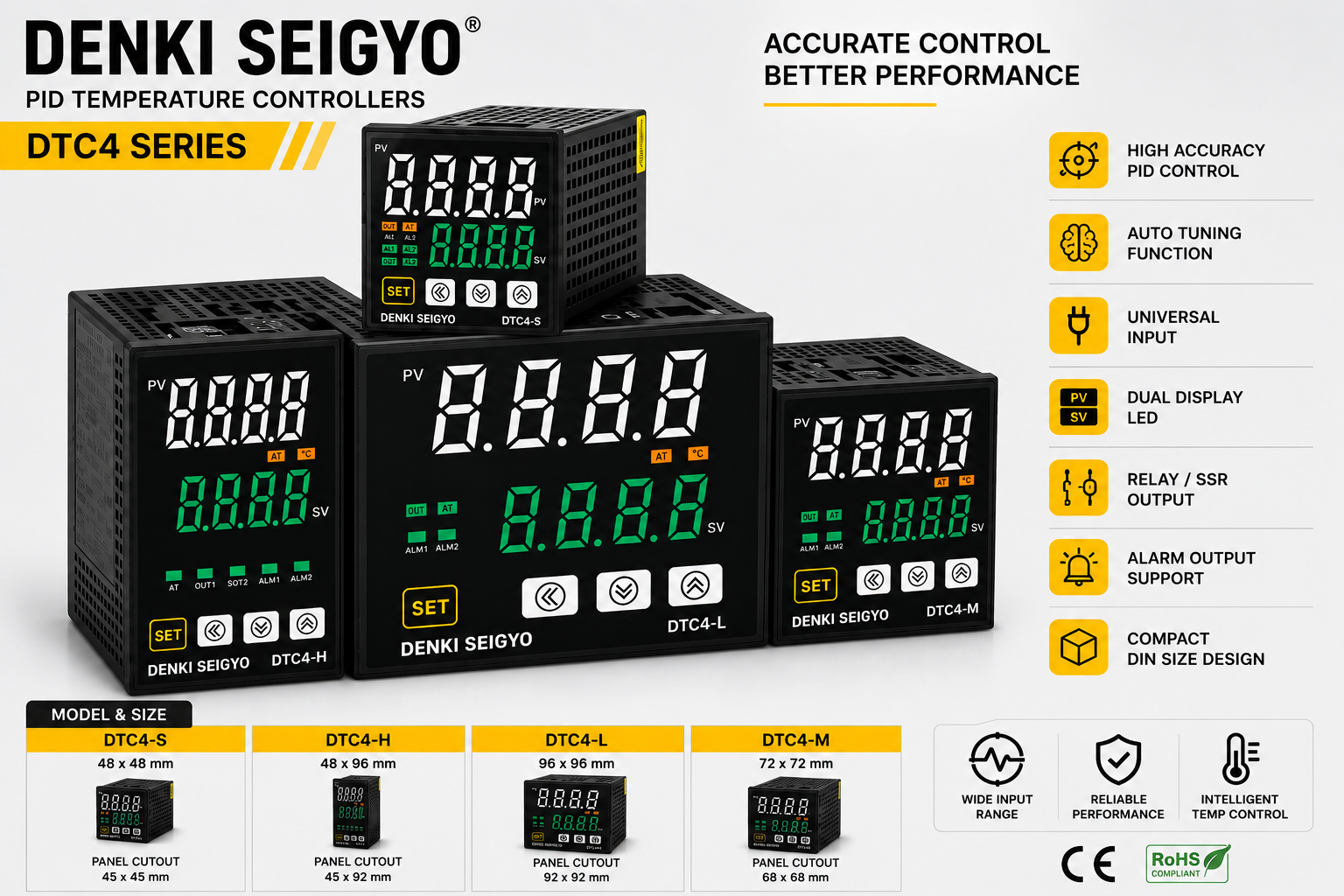


The Denki Seigyo DTC4S-2AASR is a compact, high-precision PID Digital Temperature Controller designed for accurate temperature regulation in industrial heating and cooling applications. Featuring a 48 × 48 mm DIN panel size, 4-digit dual LED display, dual alarm outputs, SSR drive and relay outputs, and 220 VAC power supply, the DTC4S Series delivers stable temperature control, fast response, and reliable operation in demanding industrial environments. Similar industrial controllers in this class commonly support universal sensor inputs, auto-tuning PID control, and multiple output configurations.
Key Features
- 48 × 48 mm DIN panel size
- Bright 4-digit dual LED display (PV & SV)
- Advanced Auto-Tuning PID control
- ON/OFF and PID control modes
- SSR drive output
- Relay control output
- Dual independent alarm outputs
- Universal temperature sensor input
- Supports Thermocouple and RTD inputs
- Heating and cooling control
- High measurement accuracy
- Fast sampling and response
- Password protection
- Compact panel-mount design
- Excellent EMI resistance
- Long service life
Product Model
| Model | Display | Supply Voltage | Output | Alarm |
|---|---|---|---|---|
| DTC4S-2AASR | Dual 4-digit LED | 220 VAC | SSR + Relay | 2 Alarm Outputs |
Model Code Explanation
| Code | Description |
|---|---|
| D | Denki Seigyo |
| TC | Temperature Controller |
| 4 | 4-Digit Dual Display |
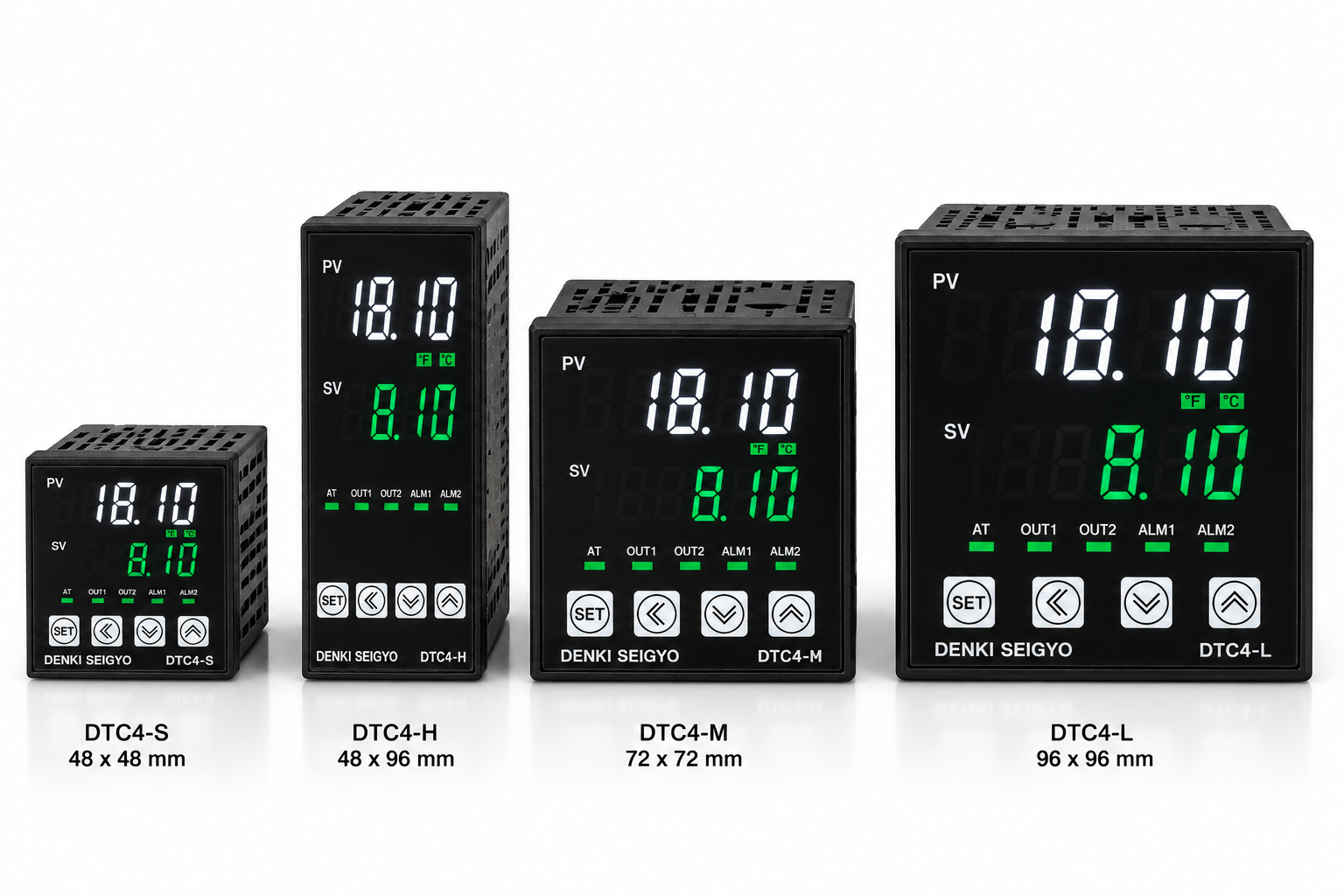
| S | Square DIN Size (48 × 48 mm) |
| 2A | 2 Alarm Outputs |
| A | 220 VAC Power Supply |
| S | SSR Drive Control Output |
| R | Relay Control Output |
Technical Specifications
General Specifications
| Parameter | Specification |
|---|---|
| Controller Type | Digital PID Temperature Controller |
| Display | Dual 4-digit LED (PV & SV) |
| Control Method | PID / ON-OFF |
| Panel Size | 48 × 48 mm |
| Mounting Size | 45 × 45 mm |
| Accuracy | ±0.5% FS ±1 Digit |
| Sampling Time | Approx. |
| 100 ms |
Input Specifications
| Parameter | Specification |
|---|---|
| Sensor Input | Universal Input |
| Thermocouple | K, J, T, E, R, S, B, N |
| RTD | Pt100 |
Output Specifications
| Parameter | Specification |
|---|---|
| Control Output | Relay + SSR Drive |
| Relay Contact Rating | 250 VAC, 3 A (Resistive) |
| SSR Drive Output | 12 VDC Pulse |
| Alarm Outputs | 2 Independent Alarms |
Electrical Specifications
| Parameter | Specification |
|---|---|
| Power Supply | 220 VAC, 50/60 Hz |
| Power Consumption | ≤5 VA |
| Insulation Resistance | ≥100 MΩ |
| Dielectric Strength | 2000 VAC / 1 Minute |
Environmental Specifications
| Parameter | Specification |
|---|---|
| Operating Temperature | 0°C to +50°C |
| Storage Temperature | −20°C to +70°C |
| Humidity | 35–85% RH (Non-condensing) |
Mechanical Specifications
| Parameter | Specification |
|---|---|
| Panel Dimensions | 48 × 48 mm |
| Panel Cutout | 45 × 45 mm |
| Mounting | Panel Mount |
| Housing Material | Flame-Retardant ABS |
| Display Color | Red / Green LED |
Display Functions
The dual LED display provides clear real-time process monitoring.
- PV Display – Actual Process Temperature
- SV Display – Set Temperature
- Output Status Indicator
- Alarm Indicators (AL1 / AL2)
- Auto-Tuning Indicator
- Control Output Indicator
Control Functions
- Auto-Tuning PID
- Manual PID Adjustment
- Heating Control
- Cooling Control
- ON/OFF Control
- Sensor Offset Correction
- Alarm Delay
- Temperature Calibration
- Power Failure Memory
- Parameter Lock
Typical Applications
The DTC4S-2AASR is ideal for:
- Plastic Injection Machines
- Packaging Machinery
- Industrial Ovens
- Heat Treatment Furnaces
- Food Processing Equipment
- Laboratory Equipment
- Textile Machinery
- Drying Ovens
- Thermoforming Machines
- Rubber Processing
- Pharmaceutical Equipment
- Industrial Automation Panels
Advantages
- High-precision PID temperature control
- Fast response with minimal overshoot
- Compact 48 × 48 mm DIN size
- Universal sensor compatibility
- Dual alarm outputs for enhanced safety
- Flexible SSR and relay control outputs
- Easy parameter configuration
- Stable operation in industrial environments
- Long operational life with minimal maintenance
Why Choose Denki Seigyo DTC4S Series?
- Industrial-grade PID control
- Bright dual LED display
- Universal temperature sensor input
- SSR and relay outputs in one controller
- Dual programmable alarms
- Compact DIN-standard design
- Reliable performance for continuous industrial operation
Frequently Asked Questions
What is the panel size of the DTC4S-2AASR?
The DTC4S-2AASR has a 48 × 48 mm DIN panel size with a 45 × 45 mm panel cutout, making it suitable for standard industrial control panels.
Which temperature sensors are supported?
The controller supports multiple thermocouple types (K, J, T, E, R, S, B, N) and Pt100 RTD sensors, providing flexibility for various industrial applications.
What outputs are available?
The DTC4S-2AASR includes:
- SSR Drive Output
- Relay Control Output
- Two Independent Alarm Outputs
Does the controller support Auto-Tuning PID?
Yes. The controller features Auto-Tuning PID control to optimize temperature regulation, minimize overshoot, and improve process stability.
What industries use the DTC4S-2AASR?
It is widely used in plastic processing, packaging machinery, ovens, furnaces, food processing, laboratories, textile equipment, thermoforming machines, pharmaceutical systems, and industrial automation.
Product Summary
The Denki Seigyo DTC4S-2AASR Digital PID Temperature Controller is a compact 48 × 48 mm controller that combines dual 4-digit LED displays, Auto-Tuning PID control, SSR and relay outputs, dual alarm functions, and 220 VAC operation. Designed for reliable and precise temperature regulation, it is an ideal solution for industrial heating, cooling, and process control applications requiring stable performance and easy integration.